Beta-Alanine in MemoHoney: A Sports Amino Acid in a Tiny Amount
Quick answerBeta-alanine is an amino acid the body uses to build carnosine in muscle. Each MemoHoney capsule lists 40 mg. Sports studies used 4 to 6 g a day, so 40 mg is about 1% of the low end. At that amount, the known tingling side effect is unlikely. No study links this dose to memory.
- 60-day satisfaction window
- Free US shipping on 3 and 6 bottles
- Where it is named
- Printed with its own amount on the Supplement Facts panel
- Amount per capsule
- 40 mg
- Doses used in studies
- 4-6 g a day in sports studies (Trexler et al., ISSN 2015)
- Share of the studied dose
- About 1% of 4 g
- Also called
- Amino acid used in sports formulas
What kind of amino acid is beta-alanine?
Beta-alanine is an amino acid that your body makes on its own. Unlike most amino acids, it does not get built into proteins. Its main known job is to team up with another amino acid, histidine.
Together they form carnosine, a compound stored in muscle. Carnosine helps muscles handle the acid that builds up during hard, fast effort. That is why beta-alanine shows up in workout powders and sports drinks.
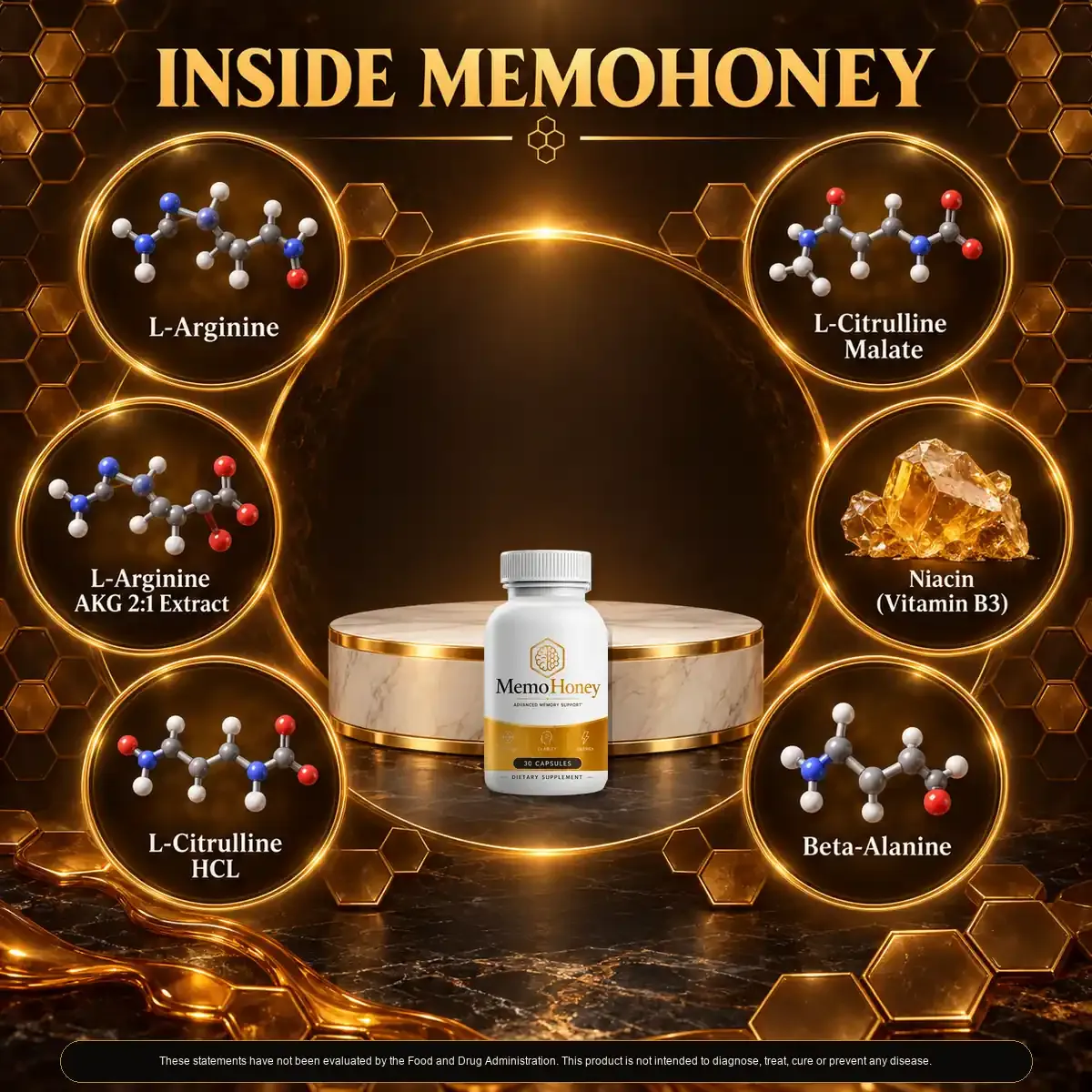
On the MemoHoney panel, beta-alanine is the last of the seven printed lines. It sits next to arginine, citrulline, niacin and calcium. You can see all seven lines on the ingredients page.
How does 40 mg compare with the doses in studies?
- 40 mgPrinted in each MemoHoney capsule
- 4-6 gDaily dose in sports studies
- About 1%40 mg as a share of 4 g
| Source | Beta-alanine amount | How it was taken | Where it comes from |
|---|---|---|---|
| MemoHoney label | 40 mg | Once a day, inside 1 capsule | Read from the Supplement Facts panel |
| Sports studies, low end | 4 g (4,000 mg) | Daily, split into doses of 2 g or less | (Trexler et al., ISSN 2015) |
| Sports studies, high end | 6 g (6,000 mg) | Daily, for at least 2 weeks | (Trexler et al., ISSN 2015) |
| Share of the low end | About 1% | 40 mg divided by 4,000 mg | Our math |
A 2015 position stand from the International Society of Sports Nutrition pulled the research together (Trexler et al., ISSN 2015). Daily intakes of 4 to 6 g, for at least 2 weeks, raised carnosine in muscle.
One capsule gives 40 mg. That is 4,000 mg compared with 40 mg, so about 1% of the low end. Being tiny does not guarantee zero effect. It does mean this is not the amount that was tested.
Why is the tingling side effect unlikely here?
Beta-alanine is famous for one thing besides sport: a prickly, tingling skin feeling. The medical word is paraesthesia. It tends to follow a large single dose and then fade.
That 2015 paper lists tingling as the sole side effect reported in the studies (Trexler et al., ISSN 2015). Researchers kept each single dose at 2 g or less to reduce it. A 40 mg capsule is 2% of one of those split doses.
Noticed a new skin feeling?
If you do feel tingling, flushing or itching after a capsule, write down the time and what you ate. Niacin, another line on this label, can cause flushing at much higher amounts. Tell your doctor about any new reaction.
Our niacin page explains why the 7.5 mg of niacin here is also well below the flushing range.
Where does beta-alanine come from besides supplements?
The body makes some beta-alanine on its own. You also take in some through food. Meat, poultry and fish contain carnosine and related compounds, which the body breaks down into beta-alanine.
That means people who eat animal foods get some beta-alanine without a capsule. People who eat a plant-based diet rely more on what the body makes.
We have not found a published daily need for beta-alanine. It has no Daily Value, which is why the label marks it with a double asterisk.
Why would a memory label include a sports amino acid?
The MemoHoney label does not explain why beta-alanine is there. The sales page lists it among the named ingredients but gives no dose reason. We can only describe what the research says.
The beta-alanine research we cite was about muscle and exercise. It measured carnosine and workout results, not memory, focus or clarity. So we cannot point to a study that ties this line to the words on the front label.
| Amino acid line | MemoHoney amount | Doses used in studies | Share |
|---|---|---|---|
| Beta-alanine | 40 mg | 4-6 g a day | About 1% |
| L-arginine (two forms) | 400 mg | 3.3 g a day in a small memory trial | About 12% |
| L-citrulline (two forms) | 200 mg | Gram doses in blood pressure trials | A small fraction |
For the bigger picture, our how it works page walks through the blood flow idea behind arginine and citrulline.
Is MemoHoney a sensible pick for workouts?
No. If your goal is exercise, MemoHoney is not built for it. The beta-alanine line is far below the sports range, and the label is aimed at memory words, not training.
People who want beta-alanine for sport usually buy a single-ingredient product with the grams printed. If that is you, ask your doctor first, especially past 50 or with a heart condition.
Read the gram amount
Sports labels list beta-alanine in grams. A milligram amount is a different product category.
Count every product
Pre-workout powders often stack arginine, citrulline and beta-alanine. Add them up with any capsule you take.
Ask about your heart
Hard exercise and blood pressure medicine both deserve a check-up talk before you change routines.
Honest note: what is and is not known
What the evidence supports
- Every amount is printed, so you know it is 40 mg
- Beta-alanine has a long sports research record
- Tingling is unlikely at such a small dose
What it does not support
- 40 mg is about 1% of the low study dose
- The studies measured muscle, not memory
- No study has tested MemoHoney as a whole
This page is not a reason to buy or to skip. It is a plain account of one small line on the label.
Does beta-alanine mix badly with heart medicines?
We found no well-known drug warning for beta-alanine at small doses. The bigger question is the rest of the capsule. Arginine and citrulline may lower blood pressure (Mayo Clinic, L-arginine) (WebMD, L-citrulline).
Show the full label to your doctor or pharmacist first if this is you
- You take blood pressure medicine
- You use nitrates such as nitroglycerin
- You take ED pills such as sildenafil
- You have had a heart attack
- You also use a workout powder with arginine, citrulline or beta-alanine
- The label caution applies to you: pregnant, nursing or younger than 18
The side effects page covers each of these in more detail, with sources.
How do you take the beta-alanine in MemoHoney?
You do not take it on its own. The 40 mg comes inside the one daily capsule with everything else. Swallow it with 8 oz of water, ideally 20 to 30 minutes ahead of a meal, per the label.
Stacking capsules to chase a sports dose is a bad idea. You would need about 100 capsules for 4 g, and the arginine and citrulline would rise too. Going past one capsule a day also breaks the label's own dose limit.
Tips for building the habit are on the how to use page.
Common searches about beta-alanine, answered
What does beta-alanine do in the body?
It helps muscles build carnosine. Carnosine buffers acid during hard exercise, which is why sports formulas use it.
Can 40 mg of beta-alanine do anything?
Probably not on its own. Sports studies used 4 to 6 g a day, and 40 mg is about 1% of 4 g.
What causes the pins-and-needles feeling from beta-alanine?
Tingling, called paraesthesia, is the known side effect of larger single doses. The sports nutrition position stand calls it the only reported side effect.
Could one MemoHoney capsule cause that prickly skin feeling?
That is unlikely at 40 mg. Studies kept single doses at 2 g or less to limit tingling, and 40 mg is a small fraction of that.
Does beta-alanine improve memory?
That has not been shown. The research we cite measured muscle carnosine and exercise, not memory, and no study has tested MemoHoney.
Should people over 60 worry about 40 mg of beta-alanine?
At 40 mg, beta-alanine itself is a small amount. The rest of the MemoHoney capsule, mainly arginine and citrulline, is what matters for people on heart or blood pressure medicine.
Can I take a beta-alanine pre-workout with this capsule?
Ask a pharmacist first. Many pre-workout powders also contain arginine or citrulline, so the amounts add up with this capsule.
Is beta-alanine the same as alanine?
No. They are related amino acids with different jobs. Beta-alanine is the one that pairs with histidine to make carnosine.
How long does beta-alanine take to work in sports studies?
The studies gave it daily for at least 2 weeks to raise muscle carnosine. That timeline used grams a day, not milligrams.
Weighing the beta-alanine in MemoHoney?
One capsule a day, 30 per bottle, with every amount printed on the label and no honey in it. Packs start at $49 a bottle on 6 bottles, with a 60-day money-back window. On heart or blood pressure medicine? Check with your doctor first.