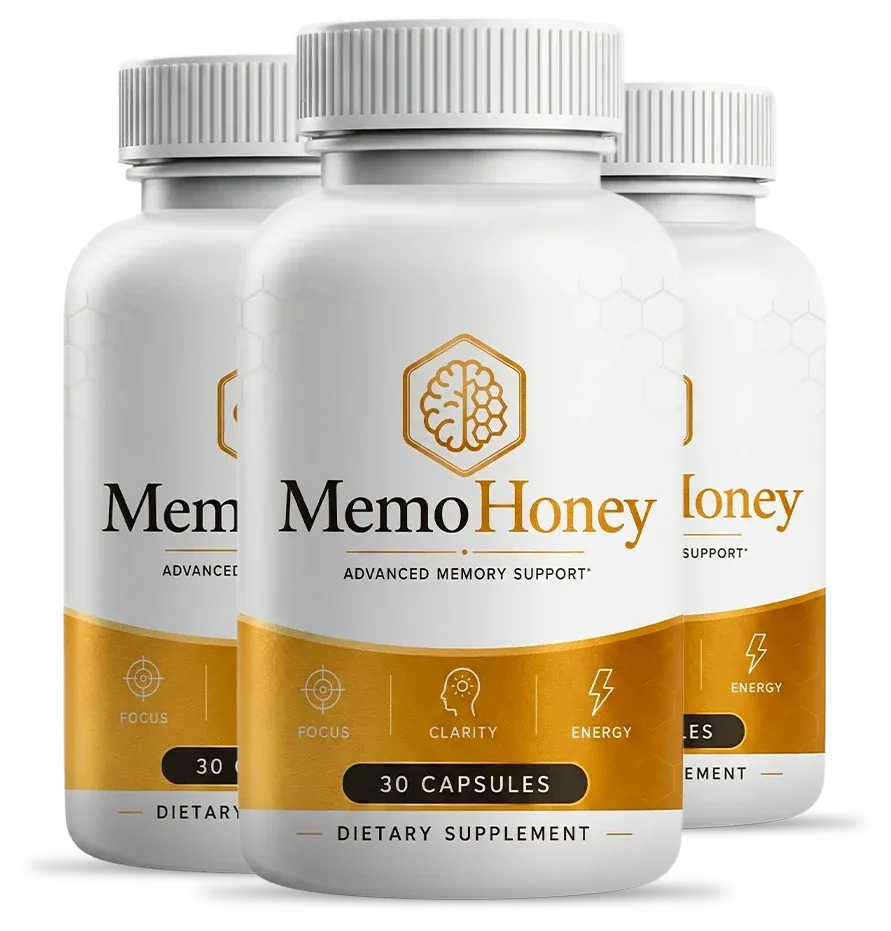
How to Read a Memory Supplement Label, Using MemoHoney as the Example
Quick answerIgnore the front and go to the Supplement Facts panel. Check the serving size, then the amount on every line, any blend, the star marks, the claim asterisk and the distributor. Last, compare the name with the list. On MemoHoney, every line has an amount and there is no blend, but no honey is listed despite the name.
- 60-day satisfaction window
- Free US shipping on 3 and 6 bottles
Why read the back panel before the front?
A seven-step method you can use on any bottle.
The front of a bottle is an ad. The Supplement Facts panel is the record. Federal rules require that panel to list each dietary ingredient with its amount per serving (21 CFR 101.36).
This guide gives you a seven-step method for any memory product. Each step is then tried on the MemoHoney label, so you can see how it works on a real bottle.
The seven steps at a glance
Steps 1 and 2: serving size comes first
Serving size tells you how many capsules the amounts describe. Some memory products use two, three or four capsules per serving. In that case, one capsule holds only part of each number.
MemoHoney is simple here. The panel says Serving Size 1 Capsule and Servings Per Container 30. So each amount is what one capsule holds, and one bottle covers 30 days.
Step 3: read the amount on each line
Next, read the weight beside each line. Vitamins and minerals also show a percent Daily Value. That figure tells you how much of a day's reference amount one serving gives.
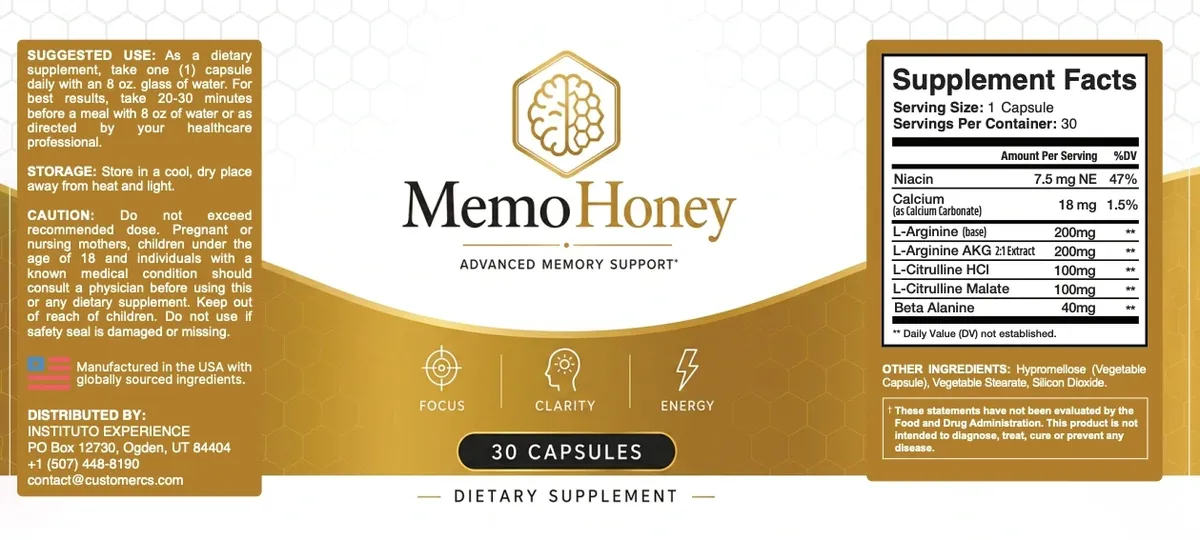
On MemoHoney, niacin shows 47% and calcium shows 1.5%. The other five lines show a weight but no percent. The panel below is retyped from the label image.
Supplement Facts
Serving Size: 1 Capsule
Servings Per Container: 30
| Amount per serving | %DV | |
|---|---|---|
| Niacin | 7.5 mg NE | 47% |
| Calcium (as Calcium Carbonate) | 18 mg | 1.5% |
| L-Arginine (base) | 200 mg | † |
| L-Arginine AKG 2:1 Extract | 200 mg | † |
| L-Citrulline HCl | 100 mg | † |
| L-Citrulline Malate | 100 mg | † |
| Beta Alanine | 40 mg | † |
† Daily Value not established.
Other ingredients: Hypromellose (Vegetable Capsule), Vegetable Stearate, Silicon Dioxide.
Retyped from the label image so it can be read and searched. The bottle in your hand is the final word.
What do the two stars on a label mean?
Two stars next to a line mean the Daily Value is not established. Amino acids such as arginine have no set daily target, so no percent can be printed.
Count the double stars on the MemoHoney panel and you get five: the four arginine and citrulline lines plus beta-alanine. The symbol is normal. It does not mean anything is missing or unsafe.
Step 4: does the label hide a blend?
A proprietary blend lists a group of ingredients under one total. You learn the total but not the share of each part. That makes it hard to compare a dose with research.
MemoHoney has no blend. Each amino acid line has its own number, and the five add up to 640 mg. The bar below shows how that total splits. Tap a part to open its page, such as L-arginine.
- L-Arginine (base) 200 mg
- L-Arginine AKG 2:1 Extract 200 mg
- L-Citrulline HCl 100 mg
- L-Citrulline Malate 100 mg
- Beta Alanine 40 mg
- Niacin 7.5 mg NE
- Calcium 18 mg
Why a salt form weighs more than it gives
Some lines name a salt or carrier form. The printed weight then includes that carrier. On MemoHoney, the AKG, HCl and malate lines each weigh more than the amino acid they deliver.
| Label line | Printed weight | What the extra part is |
|---|---|---|
| L-Arginine (base) | 200 mg | None; this is the plain amino acid |
| L-Arginine AKG 2:1 Extract | 200 mg | Alpha-ketoglutarate carrier |
| L-Citrulline HCl | 100 mg | Hydrochloride salt |
| L-Citrulline Malate | 100 mg | Malic acid carrier |
Step 5: what does the claim asterisk mean?
Now look at the front. A claim about how a product supports the body, like memory support, must come with the FDA statement, often linked by an asterisk. On MemoHoney, “Advanced Memory Support*” has that asterisk, and it leads to the line saying the claim was not evaluated.
Supplements go on sale without any FDA approval step (FDA, Q&A on Dietary Supplements). Ads still need solid scientific evidence for health claims (FTC, Health Products Compliance Guidance). Those three front icons for focus, clarity and energy are artwork; nobody tested them.
Step 6: who is behind the bottle?
The distributed-by line names who sells the product. MemoHoney lists Instituto Experience, PO Box 12730, Ogden, UT 84404, with a phone number and an email.
A PO box is not a street address, and the factory is not named. The only origin note reads “Manufactured in the USA with globally sourced ingredients.” The GMP and FDA-registered badges on brand graphics name no facility or certificate number.
A brand badge. It refers to the FDA's supplement manufacturing rules. No facility or certificate number is published.
A brand badge. A facility listing is not FDA approval of the product, and the facility is not named.
Step 7: does the MemoHoney name match the list?
Last, put the name and the pictures next to the ingredient list. Ask whether they match.
Here MemoHoney fails the test. The name says honey and the front shows a honeycomb. The panel lists no honey in any form. The honey check page goes through it point by point. Tap any number on the label image below for a note on that spot.
Tap a number to read that part of the label. The full label panel is shown as printed.
- Serving size: 1 capsule; 30 servings per container, so one bottle lasts 30 days.
- Niacin: 7.5 mg NE, 47% of the Daily Value.
- Calcium: 18 mg as calcium carbonate, 1.5% of the Daily Value.
- L-Arginine: 200 mg base plus 200 mg as AKG 2:1. No Daily Value exists (**).
- L-Citrulline: 100 mg as HCl plus 100 mg as malate.
- Beta Alanine: 40 mg, the smallest amino acid line.
- Other ingredients: Hypromellose vegetable capsule, vegetable stearate, silicon dioxide. No honey anywhere on the label.
- Suggested use: 1 capsule daily with 8 oz of water, best 20-30 minutes before a meal.
- Caution: Not for pregnancy, nursing or under 18; a known medical condition means ask a physician first.
- Distributed by: Instituto Experience, PO Box 12730, Ogden, UT 84404.
- Front claim: “Advanced Memory Support*”: the mark points to the FDA statement.
How do the amounts compare with research?
Once every line has an amount, you can compare it with research. On MemoHoney, every amino acid amount sits well below the doses studied.
Honest note
MemoHoney itself has never been tested in a published study. The closest trial gave frail, hypertensive older adults roughly 3.3 g of arginine daily for a month (Mone et al., 2022). This label lists 400 mg of arginine across two forms.
Scorecard: the MemoHoney label against the method
| Method step | MemoHoney result | Verdict |
|---|---|---|
| Serving size | 1 capsule, 30 servings | Clear |
| Amount on every line | Yes, all seven lines | Clear |
| Blend | None | Clear |
| Symbols | ** on five lines; * on the front claim | Normal and explained |
| Distributor | Named, with a PO box; factory not named | Partly clear |
| Doses vs research | Far below studied amounts | Weak |
| Name vs list | Honey in the name, none on the panel | Mismatch |
Take this to the store or the pharmacy
- Photograph the Supplement Facts panel before you buy
- Write down the serving size and every amount
- Circle any blend that hides individual amounts
- Ask your pharmacist about each ingredient and your medicines
- Compare the product name and pictures with the list
- Note the distributor, phone number and lot number
Label reading FAQ: questions people ask
How do you read a supplement facts label?
Start with the serving size, then read the amount next to each ingredient. Check for blends, symbols and the distributor line before you look at the front claims.
What does proprietary blend mean on a supplement label?
It means several ingredients share one total weight. The maker does not have to say how much of each is inside, so you cannot compare them with research.
Why do some supplement labels have star symbols?
A single asterisk after a claim usually points to the FDA statement that the claim was not evaluated. Two stars or a dagger in the panel mean no Daily Value exists.
What does percent Daily Value mean on a supplement?
It shows how much of a day's target one serving gives. For example, 47% for niacin means about half of the reference amount.
Why does the serving size matter?
Every amount on the panel is per serving. If a serving is three capsules, one capsule holds only a third of each amount.
Who is the distributor named on a supplement bottle?
It names the company that sells the product, which is often not the factory. A label may name a distributor and leave the manufacturer out.
Is 200 mg of arginine AKG the same as 200 mg of arginine?
No. Part of the weight is the alpha-ketoglutarate carrier. The arginine share is smaller than the number on the line.
Can a supplement's name tell you what is inside?
Not reliably. MemoHoney is named after honey and shows a honeycomb, yet its panel lists no honey.
Are GMP and FDA-registered badges certifications?
Not on their own. On brand graphics they are badges; look for a named facility or a certificate number before treating them as proof.
Read the label and still want MemoHoney?
One capsule a day, seven printed lines, no honey. Packs run $49 to $79 a bottle on the sales page. Take the panel to your doctor first if you use heart or blood pressure medicine.