How Does MemoHoney Work? The Nitric Oxide Idea
Quick answerMemoHoney is built around blood vessels and nitric oxide.
Arginine is the raw material the body uses to make nitric oxide, which lets vessel walls loosen, and citrulline is turned back into arginine. Each capsule lists 400 mg of arginine and 200 mg of citrulline.
See every ingredient and its amount.
- 60-day satisfaction window
- Free US shipping on 3 and 6 bottles
What is MemoHoney meant to do?
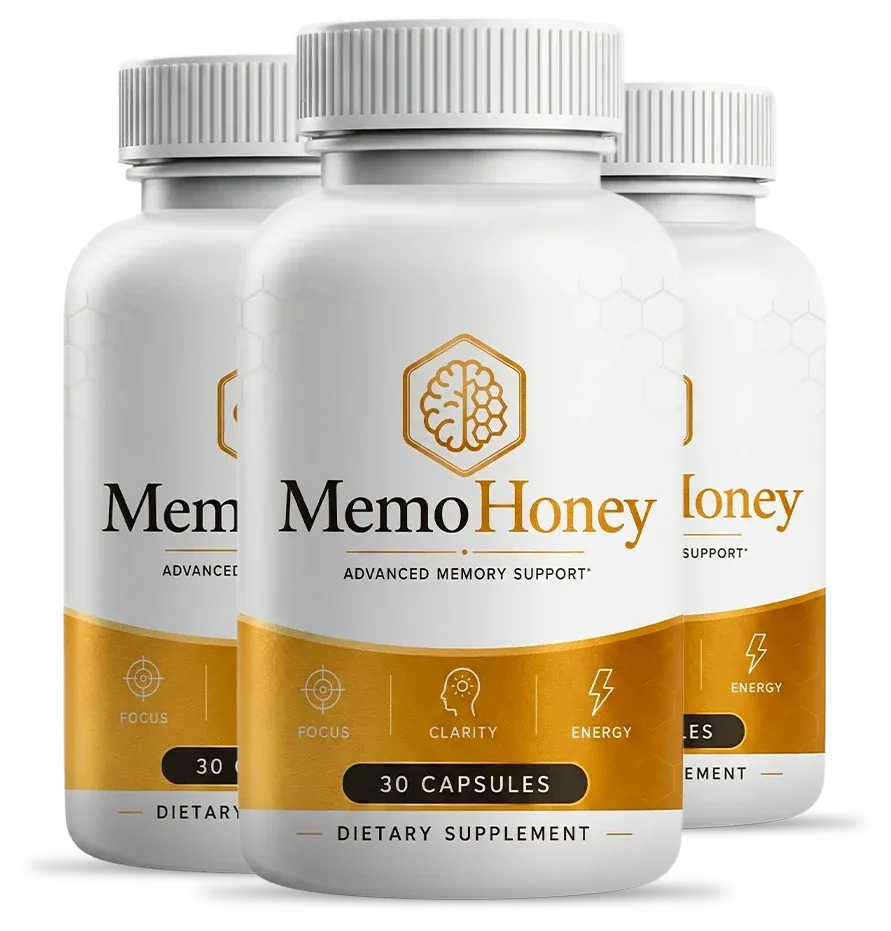
The front label says “Advanced Memory Support*” with three icons: focus, clarity and energy. The asterisk is important. It points to the FDA statement printed on the same label.
That fine print says the FDA has not evaluated the claims and that the product is not meant to diagnose, treat, cure or prevent any disease. In plain words, nobody at the FDA checked the memory wording.
The label does not explain how the capsule is supposed to support memory. To understand the idea, you have to look at what the ingredients do in the body.
What happens after you swallow a capsule?
This is the textbook path for arginine and citrulline. The body uses arginine to make nitric oxide, and it turns citrulline into arginine (Schwedhelm et al., 2008). Nitric oxide then relaxes blood vessel walls.
That is why these two amino acids are sold in “nitric oxide” and workout formulas. The same path is what makes them a concern for people on blood pressure medicine.
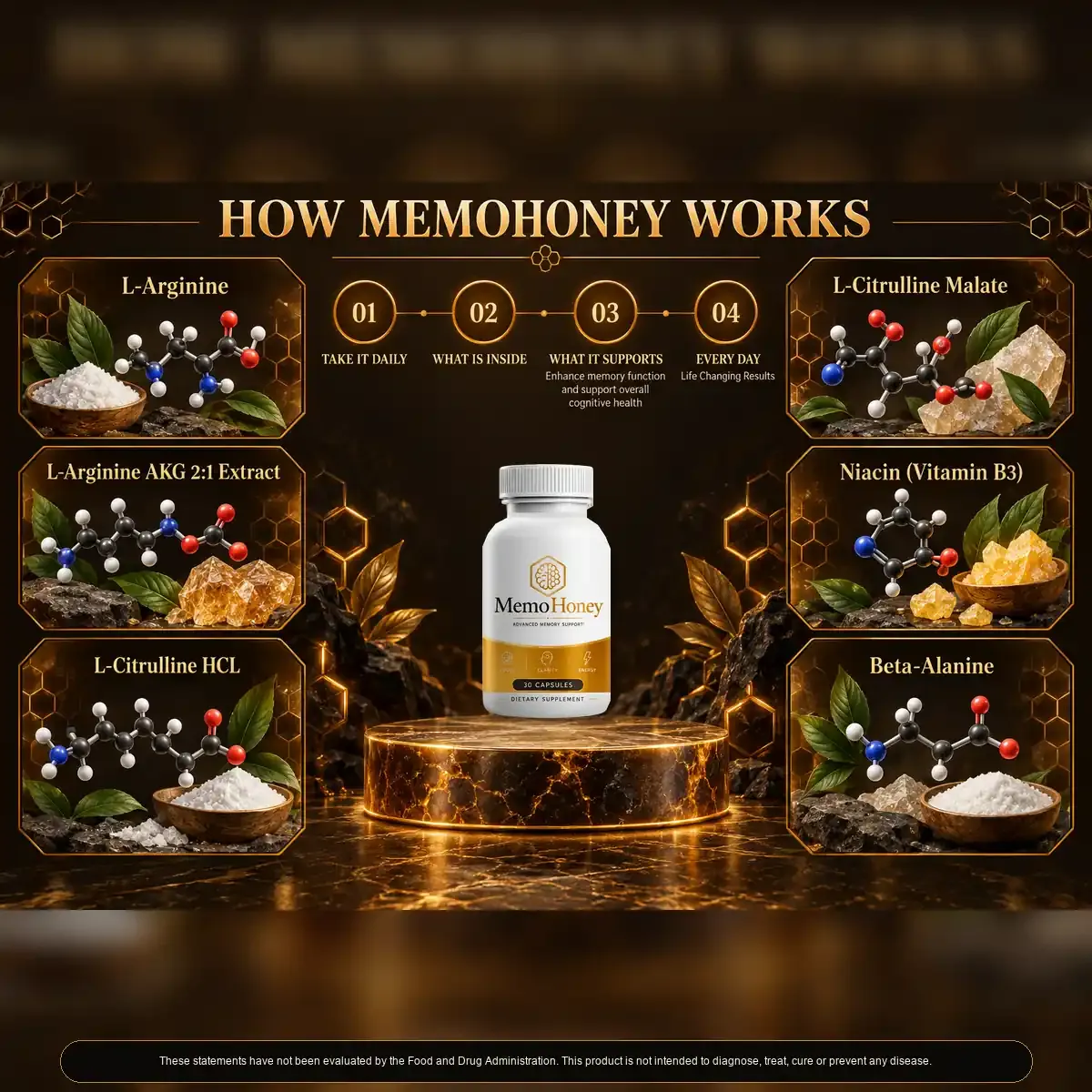
What does the brand's how-it-works graphic show?
The maker's image places six named ingredients around a bottle. It shows the two arginine forms, the two citrulline forms, niacin and beta-alanine.
Calcium is left out, but the label prints it as a seventh line at 18 mg. The graphic shows no doses, no study and no arrows to the brain.
The label wins when the two differ. Our Supplement Facts page retypes every line as printed.
Why does an amino acid capsule say “Advanced Memory Support”?
The label does not say. The likely reason is a blood flow argument. The brain depends on steady blood flow, and nitric oxide helps vessels widen. So a product that feeds the nitric oxide path gets marketed for the brain.
That chain has a weak link. Showing that arginine can relax vessels at gram doses does not show that 400 mg improves memory. Those are different questions, and only the first has been studied much.
Supplement makers can use words like “support” without FDA approval (FDA, Q&A on Dietary Supplements). The FTC still expects health claims in ads to be backed by sound evidence (FTC, Health Products Compliance Guidance).
How much of each ingredient is in one capsule?
- L-Arginine (base) 200 mg
- L-Arginine AKG 2:1 Extract 200 mg
- L-Citrulline HCl 100 mg
- L-Citrulline Malate 100 mg
- Beta Alanine 40 mg
- Niacin 7.5 mg NE
- Calcium 18 mg
Each capsule holds 640 mg of amino acids across five lines. Arginine makes up 400 mg in two forms, and citrulline makes up 200 mg in two forms. Beta-alanine adds 40 mg. Niacin and calcium are listed separately.
Part of the AKG, HCl and malate forms is carrier weight, not the amino acid itself. The L-arginine page and L-citrulline page explain each form.
What has research on these amino acids found?
| Outcome studied | Dose | What was found | Source |
|---|---|---|---|
| Blood pressure | 4-24 g arginine a day | Small average drop in 11 trials | (Dong et al., 2011) |
| Blood pressure | Gram doses of arginine or citrulline | Some drops; results vary | (Khalaf et al., 2019) |
| Blood arginine levels | Citrulline vs arginine by mouth | Citrulline raised arginine more efficiently | (Schwedhelm et al., 2008) |
| Thinking tests | 3.3 g arginine a day, 4 weeks | Scores differed from placebo in 72 frail adults with high blood pressure | (Mone et al., 2022) |
| MemoHoney itself | 1 capsule a day | Not studied | No published trial |
Across 11 blood pressure trials, arginine at 4 to 24 g a day lowered pressure a few points (Dong et al., 2011). A later review of arginine and citrulline found mixed results at gram doses (Khalaf et al., 2019).
One small trial looked at thinking tests (Mone et al., 2022). Seventy-two frail older adults with high blood pressure took 3.3 g of arginine a day for 4 weeks. Scores differed from placebo. The trial was small, short and single-blind, and the capsule's 400 mg is about 12% of that daily dose.
Honest note: what is known and what is not
What is reasonably known
- Arginine is used to make nitric oxide
- Citrulline raises blood arginine
- Gram doses can lower blood pressure a little
- Every amount is printed on the label
What is not known
- No study of MemoHoney has been published
- Healthy-adult memory gains from these amino acids are not shown in reviews
- The capsule doses are a small share of studied doses
- Brain blood flow was not measured with this product
L-ArginineAbout 12%
Beta AlanineAbout 1%
Memory evidenceNo product study
No study of MemoHoney has been published. The one arginine memory trial we found was small, short and used about 8 times more arginine. (Mone et al., 2022)
Does the honey name play any part in how it works?
No. No honey is listed on the label or the sales page. The name and the honeycomb pattern are branding, so there is nothing from honey to explain here.
Some buyers expected a honey product and were surprised. Our page on whether it contains honey goes through the label line by line.
Who should not rely on this mechanism without a doctor?
Blood pressure and heart medicines
The same path that relaxes blood vessels can add to blood pressure drugs, nitrates such as nitroglycerin, and ED pills such as sildenafil (Mayo Clinic, L-arginine) (WebMD, L-citrulline). Ask your doctor before you start.
Patients given arginine for six months after a heart attack did no better, more of them died, and the VINTAGE MI trial ended early (Schulman et al., JAMA 2006). If you have had a heart attack, talk with your cardiologist first.
Forgetting that upsets everyday routines deserves an appointment, because a number of its causes can be fixed (NIA, Memory problems and aging). Sudden confusion or trouble speaking can be a stroke: call 911 (CDC, Stroke signs). The side effects page has the full list.
How it works FAQ: questions about the MemoHoney mechanism
How is MemoHoney supposed to work?
Through blood vessels, in theory. Nitric oxide made from arginine lets vessels open wider, and citrulline tops up arginine.
What is nitric oxide?
It is a gas the body makes from arginine. It signals the muscle in blood vessel walls to relax, so the vessels widen.
Does more blood flow to the brain mean better memory?
Not automatically. No study has shown that this capsule changes blood flow to the brain or memory in healthy adults.
Why take citrulline if the body needs arginine?
Citrulline is converted into arginine. In healthy volunteers, citrulline by mouth lifted arginine levels in the blood better than an equal dose of arginine did.
How soon would MemoHoney start working?
No one can say, because no study of the product exists. Be wary of any page that promises a timeline.
Has MemoHoney been clinically tested?
No published study of the product exists. The research on this page tested the amino acids alone, at larger doses.
Did MemoHoney go through FDA approval?
No. The FDA does not approve dietary supplements before they are sold, and the label's asterisk points to that statement.
Does the honey in the name do anything?
No honey is listed on the label or the sales page. The name and the honeycomb design are branding.
Could a nitric oxide product drop my pressure too far?
Possibly, if you already take pressure medicine. Both arginine and citrulline can push readings down, so clear it with your doctor before starting.
Understand the idea behind MemoHoney? Compare packs
One capsule a day, 30 per bottle, with every amount printed on the label and no honey in it. Packs start at $49 a bottle on 6 bottles, with a 60-day money-back window. On heart or blood pressure medicine? Check with your doctor first.