What the Numbers on the MemoHoney Label Add Up To
Quick answerOne MemoHoney capsule lists 640 mg of amino acids across five lines, plus niacin at 7.5 mg NE and calcium at 18 mg. Arginine is 400 mg, citrulline 200 mg and beta-alanine 40 mg. Every line has its own amount, so nothing hides in a blend. The salt forms weigh more than the amino acid they carry.
What does the MemoHoney Supplement Facts panel list?
Start with the whole panel, line by line. This is retyped from the label image. The bottle in your hand is the final word.
| Line | Amount | Daily Value | What it is |
|---|---|---|---|
| L-Arginine (base) | 200 mg | Not established | Free-form arginine |
| L-Arginine AKG 2:1 Extract | 200 mg | Not established | Arginine bound to alpha-ketoglutarate |
| L-Citrulline HCl | 100 mg | Not established | Citrulline hydrochloride |
| L-Citrulline Malate | 100 mg | Not established | Citrulline bound to malic acid |
| Beta Alanine | 40 mg | Not established | An amino acid used in sports formulas |
| Niacin | 7.5 mg NE | 47% | Vitamin B3 |
| Calcium (as calcium carbonate) | 18 mg | 1.5% | A mineral |
Seven lines, each with its own weight. The rules for supplement labels ask for exactly that: a line and an amount for every dietary ingredient (21 CFR 101.36). The panel also lists the other ingredients as hypromellose (vegetable capsule), vegetable stearate and silicon dioxide.
How do the 640 milligrams of amino acids split up?
Add the five amino acid lines and you get 640 mg per capsule. It is worth doing the sum yourself once, because the shares show you what the capsule is really built from.
- 62.5%arginine, 400 mg across two lines
- 31.3%citrulline, 200 mg across two lines
- 6.3%beta-alanine, 40 mg
- 640 mgall five amino acid lines together
Arginine leads by weight, with citrulline second. Beta-alanine is the smallest line. Niacin and calcium are listed separately and are not counted in the 640 mg. Because none of this sits inside a blend, you or a pharmacist can compare each number with a study, which is the main strength of the panel.
Key facts
- Serving size is one capsule, with 30 servings in each bottle.
- Five amino acid lines add up to 640 mg: arginine 200 mg plus arginine AKG 2:1 200 mg, citrulline HCl 100 mg plus citrulline malate 100 mg, and beta-alanine 40 mg.
- Niacin is 7.5 mg NE (47% of the Daily Value) and calcium is 18 mg as calcium carbonate (1.5%).
- There is no proprietary blend. Every line has a separate amount.
- Shell and fillers: a hypromellose vegetable capsule, vegetable stearate and silicon dioxide. No honey is listed.
- The amino acid amounts sit far below the doses used in research, and no study of the capsule has been published.
- MemoHoney is not FDA approved, and no supplement is.
Does the brand graphic match the panel?
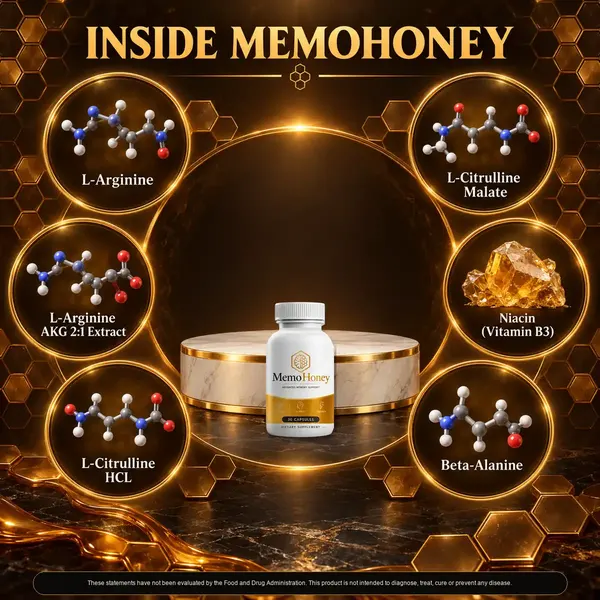
Nearly. The brand's own graphic is titled Inside MemoHoney and puts six names around a bottle. The printed label has seven lines. Calcium is the one the graphic leaves out, and the same gap shows on the sales page, which names six items. When lists disagree, the printed label wins, and we follow it.
Why does a salt form weigh more than the amino acid it carries?
Three lines name a second molecule joined to the amino acid. Alpha-ketoglutarate (AKG) rides with the second arginine. Hydrochloride (HCl) rides with the first citrulline. Malic acid, called malate, rides with the second citrulline. The label prints the weight of the whole thing.
So the AKG line gives you less than 200 mg of arginine, and each citrulline line gives you less than 100 mg of citrulline. The exact split is not printed on the label. Free-form arginine and beta-alanine carry no partner, so their weight is all amino acid. This is why we write the amino acid totals as printed amounts, not as pure amounts.
In one sports study, trained men took 12 g of arginine AKG a day for eight weeks (Campbell et al., 2006). That is 60 times the 200 mg AKG line in one capsule.
How do the label amounts stack up against study doses?
| Line | In one capsule | What the research used | Rough share |
|---|---|---|---|
| Arginine | 400 mg in two forms | 3.3 g a day in a small memory trial; 4 to 24 g a day in blood pressure trials | About 12% of the 3.3 g dose |
| Citrulline | 200 mg in two forms | Gram doses in blood pressure trials | A small fraction |
| Beta-alanine | 40 mg | 4 to 6 g a day in sports studies | About 1% of 4 g |
| Niacin | 7.5 mg NE | Adults need 14 to 16 mg NE a day | About half a day's need |
| Calcium | 18 mg | Adults should get 1,000 to 1,200 mg a day | Under 2% |
The sources behind these figures are an arginine memory trial in 72 frail older adults with high blood pressure (Mone et al., 2022), a set of blood pressure trials (Dong et al., 2011), a sports position stand (Trexler et al., ISSN 2015) and NIH fact sheets on niacin (NIH ODS, Niacin) and calcium (NIH ODS, Calcium).
A lower dose does not prove there is no effect. It just is not an amount anyone studied. That is the honest reading, and it is why we call the evidence thin.
Which lines give a percent you can check?
Only two. Niacin shows 47% of the Daily Value, and calcium shows 1.5%. Amino acids such as arginine have no set daily target, so the panel prints no percent for them. That is normal. It does not mean anything is missing.
- Niacin at 7.5 mg NE is close to half of what adults need in a day. The upper limit from supplements is 35 mg a day, so add up niacin from any multivitamin or B-complex you also take.
- Calcium at 18 mg is a tiny share of the 1,000 to 1,200 mg adults need. It will not change your calcium intake, but tell your pharmacist it is there.
- Arginine, citrulline and beta-alanine have no Daily Value. Judge them by the study doses above.
What is missing from the label, and what is not published?
The label lists no honey, no sugar and no sweetener. It prints no allergen statement. The shell is a vegetable capsule made of hypromellose, but the label makes no vegetarian or vegan claim, so ask the order desk if that matters to you.
- The factory is not named. The label says the capsules were manufactured in the USA with globally sourced ingredients.
- No certificate of analysis is published. The brand pack lists a lot, MEM-26/ME-7167, and a reference, MEM-7167-26-ME, but no document.
- No study of the finished capsule has been published.
- The exact amino acid share inside each salt form is not printed.
The two main amino acids may lower blood pressure (Mayo Clinic, L-arginine) (WebMD, L-citrulline). Show your doctor or pharmacist the whole panel if you take blood pressure pills, nitrates or ED pills, or if you have had a heart attack. This page is general information, not medical advice.
Frequently asked questions
How many milligrams of amino acids are in one MemoHoney capsule?
The five amino acid lines add up to 640 mg: 400 mg of arginine in two forms, 200 mg of citrulline in two forms and 40 mg of beta-alanine.
Does MemoHoney use a proprietary blend?
No. Every line on the Supplement Facts panel has its own printed amount, so nothing is hidden in a blend.
Why does the label list two kinds of arginine?
The label does not say why. One line is plain arginine and the other is arginine bound to alpha-ketoglutarate, a form common in sports products.
Is calcium in MemoHoney?
Yes. The printed label lists 18 mg of calcium as calcium carbonate. Some brand lists skip it, but the label shows seven lines.
How much niacin does one capsule give?
Each capsule lists niacin at 7.5 mg NE, 47% of the Daily Value. The upper limit from supplements is 35 mg a day, so add up your other products.
Do the label amounts match what studies used?
No. The amino acid amounts are a small share of the doses used in research, and no study of MemoHoney itself has been published.
Our view
As labels go, this one is clear. The sum is easy, the lines are separate and nothing hides in a blend. That is a real strength and we give it full credit.
The numbers also tell a plain story. The amino acids are in small amounts compared with the research doses, the vitamin and mineral lines are modest, and there is no honey. A tidy label does not make a capsule effective.
If you take medicine for blood pressure or the heart, bring the whole panel to your doctor or pharmacist. We may earn a commission on orders. This page was medically reviewed by Dr. Neelum Aggarwal, MD, Physician, for accuracy against the label and the cited sources.
Added it up and still curious?
The order page shows the packs, the shipping line and the 60-day terms. Compare the panel on your own bottle with this page when it arrives.
Disclosure: Memohoneysite may earn a commission when an order is placed through this button. We add no fee of our own. MemoHoney is a dietary supplement. It is not FDA approved, and no supplement is.